
Almost 30% of institutional blockchain platforms run on technologies from the Linux Foundation Decentralized Trust. Hyperledger Fabric and Besu both ranked in the top three, according to a new Ledger Insights report commissioned by LF Decentralized Trust (LFDT). We believe the market share figure is understated for reasons explained below.
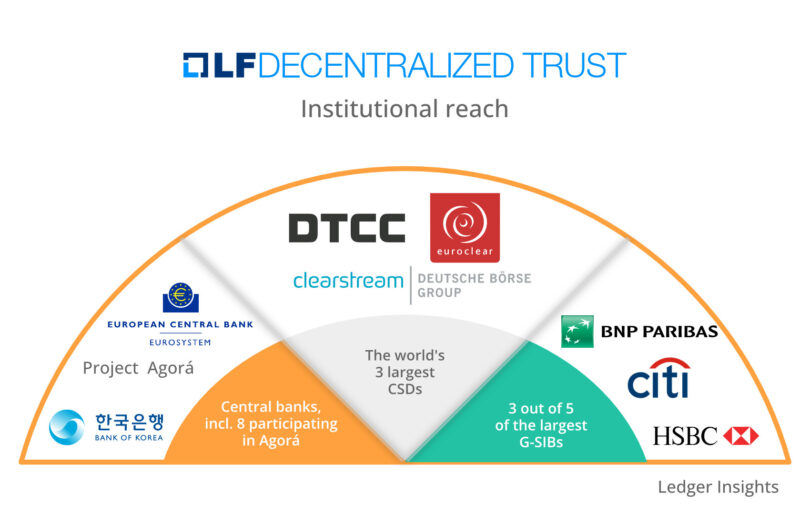
But beyond the distributed ledger market share, what stood out was the scale of the projects. Central bank initiatives including Project Agorá, which involves all G7 economies, and the Eurosystem’s Project Pontes both run on LFDT technology. So do projects at the world’s three largest central securities depositories, Clearstream, DTCC and Euroclear, and at three of the top five global systemically important banks, BNP Paribas, Citi and HSBC. Add major financial market infrastructures such as Swift and the institutional footprint is significant. For systemically important systems, open source with strong governance matters.
“Technology choices made by central banks, market infrastructure providers, and commercial banks carry implications for how financial systems will connect and evolve. They also bring long-term responsibilities for the communities maintaining the underlying code. We commissioned this research to help inform those responsibilities,” said Daniela Barbosa, General Manager, Decentralized Technologies, Linux Foundation, and Executive Director, LF Decentralized Trust.
Why the headline figure likely understates LFDT’s real market share
Over a quarter of projects have not disclosed the technologies they use at all, so the 29.4% LFDT figure only includes those that did. Part of that share reflects a head start. Hyperledger Fabric was among the earliest enterprise blockchain technologies and some of those deployments are still running. But the breadth of recent, large scale projects suggests the LFDT footprint is growing rather than coasting on legacy adoption.
Apart from Hyperledger Fabric and Besu, rounding out the top four spots are two somewhat vague categories: EVM compatible technologies and “proprietary,” which together hold a 25% market share. Our research, based on sources and the projects’ staff skills, shows that some of the EVM compatible projects almost certainly use Besu. But without confirmation they were not counted.
Then there is the proprietary category. Certain organizations are transparent that their solutions have adapted LFDT technologies, such as Citi and India’s National Payments Corporation of India (NPCI), which also manages India’s UPI payment system. The question is how many other proprietary systems genuinely start from a clean sheet rather than adapting open source foundations. Likely very few. We’re reluctant to estimate the exact uplift, but it’s reasonable to assume LFDT’s real market share is meaningfully higher than the headline figure.
The familiar attractions of open source all apply. Institutions want to avoid vendor lock in, adapt the source code and tap into a deep developer pool. When multiple institutions adopt the same open source foundation, it creates a gravitational pull. Shared technology lowers the barrier to building common standards, as highlighted by Clearstream in the report.
There is also a governance dimension that deserves more attention. Some blockchain ecosystems carry inherent conflicts of interest. Commercial incentives can drive innovation, but they can also shape infrastructure decisions in ways that don’t always align with the needs of the institutions building on top of them. For critical financial infrastructure, a foundation with neutral governance offers a counterweight that is hard to replicate elsewhere.
Blurring the lines between public and private
One observation is worth flagging. Despite the institutional preference for permissioned networks, three platforms with public blockchain roots made the top ten, with Ethereum mainnet in fifth place overall. Public chain adoption remains concentrated in fund tokenization, but its appearance in the institutional rankings alongside Fabric and Besu would have been hard to imagine a few years ago. The lines between public and permissioned infrastructure are not as sharp as they once were, and technologies like Besu that support both permissioned and permissionless deployments are well positioned for a world where institutions need to operate across both.