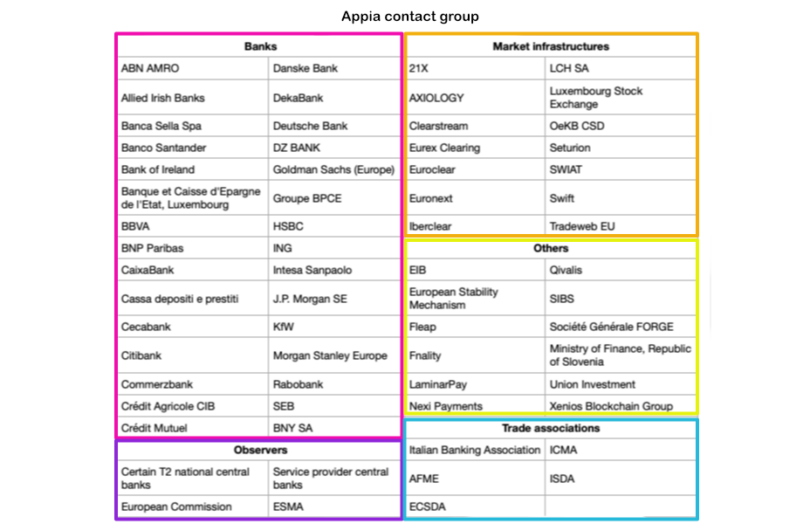
As the European Central Bank (ECB) and Eurosystem prepare for the launch of the Pontes DLT settlement solution on 21 September, they have released the names of the first four DLT operators, although it is an evolving group. They are DLT Pilot platform Axiology, Deutsche Börse’s Clearstream, German registrar Cashlink, and SWIAT, the multibank infrastructure. The four represent a cross section of infrastructure types, from an established CSD to a DLT Pilot Regime startup, reflecting the range of platforms Pontes is designed to connect with. The ECB also announced the members of the Appia contact group.
Pontes will offer two modes of settlement, a trigger solution for TARGET2 (T2) payments and DLT-based cash tokens which are often referred to as a wholesale CBDC (wCBDC), but are representations of balances on the T2 system. Alongside Pontes is the Appia initiative, which has the ambitious goal of developing the EU’s future financial market infrastructure.
“Tokenization will only deliver meaningful change to European capital markets if digital securities can connect effectively with the infrastructure institutions already rely on. Pontes is an important step in making that connection possible today,” said Marius Jurgilas, CEO of Axiology. The company is currently going through the testing and certification process ahead of the launch.
The ECB revealed the 61 members of the Appia contact group, which will now replace the Pontes market contact group and the New Technologies for Wholesale settlement Contact Group. Its participants represent a diverse group, including alternative settlement paths such as two stablecoin issuers (Qivalis and Societe Generale Forge), and Fnality, the tokenized wholesale settlement infrastructure. While the majority of members are banks, there are also DLT platforms, industry associations such as ABI, AFME, ECSDA, ICMA and ISDA, alongside numerous market infrastructures, including Clearstream, Euroclear, Eurex, Euronext, Iberclear, LCH, the Luxembourg Stock Exchange, Swift and Tradeweb. As previously noted, ESMA and the European Commission are also involved.