Kraken and Bybit have declared that the SpaceX IPO demonstrates that tokenization democratizes access to IPOs. They’re not wrong, but that’s more dependent on a broker decision, with the technology’s openness expanding access geographically. While many brokers limit IPO access to their wealthier clients, for years Robinhood and other neobrokers have enabled retail access. The brokers receive a stock allocation via the IPO and spread the scarce stocks between their clients. Kraken-owned xStocks will do the same for Kraken and Bybit clients.
xStocks are marketed as tokenized stocks but are structured notes that rely on one-for-one backing by listed stocks. They offer synthetic exposure to the stock price movement without offering direct ownership or rights, with the associated counterparty risks. Ondo Global Markets and xStocks are somewhat similar, and together have total assets under management of $1.5 billion as of today, with Ondo GM’s AUM twice that of xStocks. xStocks claims larger trading volumes of $32 billion since its launch just under a year ago.
A Bloomberg article today questioned whether the listing of SpaceX would remove the scarcity of SpaceX private stock and undermine the rationale behind tokenization. But there are two separate issues. On the one hand the underlying stock becomes less scarce as it moves from private to public markets. And then there’s tokenization, either as a synthetic or as a token that provides ownership rights. The mechanics that underpin Ondo’s and xStocks’ popular synthetics are similar to ETFs and rely on listed stocks rather than private ones. SpaceX is more likely to boost their popularity rather than detract. Different tokenization platforms provide access to unlisted unicorns, but they haven’t proven nearly as popular.
Enjoying this article? It’s the kind of coverage we produce regularly for Ledger Insights Pro subscribers. This one is ungated. Subscribe to get more like it.
Scarcity is not something solved by tokenization. By reducing costs, tokenization can help to democratize access by making it cheaper for issuers to distribute funds or other assets in smaller volumes and support fractionalization. Tokenization benefits include fewer restrictions on access enabled via open blockchains (depending on the token type), 24/7 trading on DeFi and CeFi, programmability, settlement speed and collateral mobility.
Liquidity
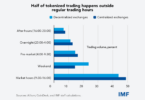
Bloomberg raised another question around liquidity. Liquidity is relevant to tokenized stocks, and may have an impact during the early chaotic trading of a new stock token. Liquidity can also impact out of hours trading, but it is less of an issue during trading hours. If demand outstrips supply, xStocks acquires more stock from its broker and mints new tokens. Likewise, if there’s too much supply it burns the tokens and sells the underlying stock via its conventional broker. This tried and tested ETF-style mechanism helps to stabilize prices during conventional trading hours.
That’s not to say that liquidity is irrelevant. In the first hours of listing, the number of tokenized stocks could be small, potentially inflating their price. That said there are already perpetual futures on Hyperliquid and arbitrageurs could run basis trades between the stock tokens and perps. xStocks could also buy additional stocks via its broker, but that may be tricky early on.
There’s another area where liquidity matters. In automated market makers (AMM), a lopsided pool can impact prices, depending on the AMM design. Both xStocks and Ondo GM tokens are semi-permissionless (similar to stablecoins) and hence can trade via DeFi AMMs.
Permissioned v semi-permissionless tokenized stocks
One open question is whether the semi-permissionless nature of these synthetic tokens could make them more popular than tokens that provide full ownership rights. For xStocks, if an investor interacts directly with a distributor such as Kraken or Bybit, they have to go through KYC and AML procedures. But once that happens, the user is free to transfer the token, including via DeFi in an anonymous manner. Some have argued that this semi-permissionless aspect could mean that US users have access via DeFi, even though the structured products are not US compliant. That said, Ondo announced plans to register the offering onshore.
The semi-permissionless attributes contrast with tokenized stocks that provide full ownership rights, with two main types in the US. The first is issuer sponsored tokens, which are few and far between so far, with Galaxy as one example. That said, major transfer agents such as Computershare and Equiniti have announced tie-ups or mergers with tokenization firms which could accelerate matters. Transfer agents participate in transactions, requiring each token holder to be identified. Securitize and Uniswap recently ran a trial for how this might work.
The other type is tokenized entitlements, with the DTC’s forthcoming tokenized stocks as a good example. The underlying stock is locked at the custodian (or broker) and a token representing full ownership rights is minted. The DTC will start live tests next month with the launch planned for October, with Nasdaq and NYSE supporting trading. DTC tokens can only be traded between wallets that have been registered with the DTCC via brokers. These sorts of tokens will be much more appealing to institutions.
Coming back to SpaceX, xStocks and Ondo were never selling scarcity, so the listing should feed them rather than starve them. The first hours of trading could still be a roller coaster. Another Musk stock, Tesla, is the most widely traded xStock and second by xStocks AUM, yet only twelfth at Ondo Global Markets. With Musk’s popularity among retail and crypto natives, SpaceX will likely be a boon for tokenization, especially for synthetics.