
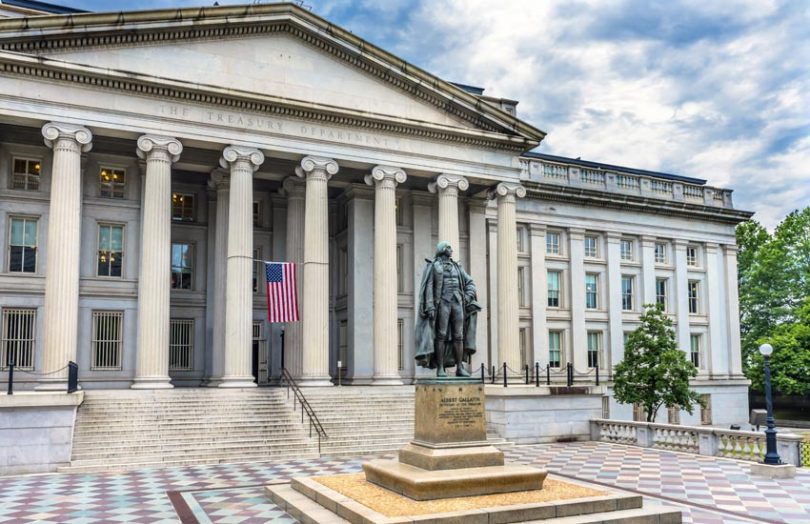
The US Treasury has published a proposed rule setting out how it will judge whether state regulatory regimes for stablecoin issuers are “substantially similar” to the federal framework under the GENIUS Act. The aim is to ensure consistent safety and soundness standards regardless of whether an issuer is regulated at the state or federal level, with states able to regulate issuers with up to $10 billion in outstanding stablecoins. Comments are due 60 days after publication in the Federal Register.
The most consequential choice in the proposal is how Treasury defines the “federal regulatory framework.” Rather than measuring states against the GENIUS Act’s statutory text alone, the definition encompasses the Act plus OCC (Comptroller) regulations and interpretations published in the Federal Register. It also includes Treasury’s own rules governing BSA and sanctions compliance, and the Federal Reserve’s anti-tying provisions. This definition effectively anchors almost all state stablecoin regulation to Treasury’s orbit. That’s because the OCC covers most of the regulated areas and reports to the Treasury Secretary, and Treasury chairs the Stablecoin Certification Review Committee that must approve each state’s regime.
Federal standards act as a floor, not a ceiling. States must “meet or exceed” all prudential requirements under the Act, but how much flexibility they have depends on the requirement. State regulators have greater leeway over non prudential requirements. On the prudential front, Treasury splits the requirements into two categories. “Uniform” requirements must be implemented consistently with the federal framework in all substantive respects. These cover reserve composition, the rehypothecation prohibition, BSA and sanctions compliance, the ban on paying interest or yield, and several others.
“State-calibrated” requirements give states design discretion, but the regulatory outcomes must be at least as stringent and protective as the federal framework. The state-calibrated list covers reserve asset eligibility, liquidity and reserve diversification, redemption limitations, capital, operational risk management, and permissible activities. In practice the state-calibrated flexibility is fairly narrow, as outlined below.
Article continues …

Want the full story? Pro subscribers get complete articles, exclusive industry analysis, and early access to legislative updates that keep you ahead of the competition. Join the professionals who are choosing deeper insights over surface level news.