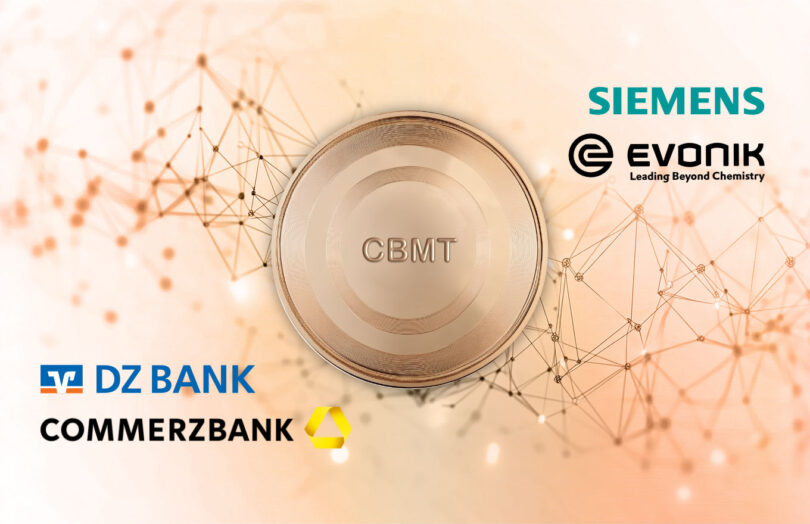
Siemens and chemicals firm Evonik have conducted the first live transactions using Commercial Bank Money Tokens (CBMT) as part of a pilot involving DZ Bank and Commerzbank. The payment related to a manufacturing process, involving IoT sensors and the consumption of Evonik chemicals. The milestone marks one of the first multi-bank deposit token transfers in the Eurozone.
The tokenized SEPA ambition
The ambition extends well beyond Germany. DZ Bank’s Claus George described CBMT as “a possible tokenized extension to existing payment systems, similar to what a Bank of Italy official recently called for in relation to a tokenized extension of SEPA, but capable of handling all currencies”. While French banks have expressed an interest in participating, the first international CBMT transactions are likely to take place between Germany and Singapore, not another EU country. There are also discussions with US and UK banks, with the aim of scaling the network quickly. The challenge is European banks have to check with each of their national supervisors, as there is no unified European legislative framework for deposits. In contrast with Singapore, many EU national central banks have only recently warmed to tokenized deposits. BaFin has approved participation in Germany.
Enjoying this article? It’s the kind of coverage we produce regularly for Ledger Insights Pro subscribers. This one is ungated. Subscribe to get more like it.
The SEPA reference is also instructive when it comes to architecture, governance and funding. “This is not about building the next walled garden. This is open,” he said. Multiple times during the interview he stated that the goal is categorically not to create a financial market infrastructure (FMI). It’s just a network. “There is no organization funding SEPA,” he said, adding that he’s not sure funding is required because infrastructure can be shared.
Openness is a core feature of the design. Rather than getting corporate DLTs to synchronize with bank networks, the banks issue deposit tokens onto corporate networks. In this case, the assets and money were transferred on the European Public Network, in what George described as a unified ledger approach. “We are bringing the asset leg and cash leg finally together, and this is where you really get better processes,” he said.
From IoT to agentic payments
While industrial use cases such as this pilot are seen as core, there are plenty of other relevant applications. George was reluctant to prescribe specific applications, preferring to leave the scope open. “It is more about, ‘Here’s some money. Do what you want,'” he said.
That said, the project has been designed with emerging use cases in mind. CBMT supports eight decimal places for micropayments, a feature that has been part of the specification for roughly two years. Corporates in the CBMT working group have recently raised agentic commerce as a potential application.
The positioning matters because stablecoins are often assumed to be the default on-chain payment instrument. George sees the two as complementary rather than competing. “The big question is do stablecoins get 80% of the market shares or eight?” he said. Stablecoins have the advantage of being live, with clear regulatory frameworks in both the US and EU. For corporates, the deposit token is the more natural instrument, and it can serve as the payment layer for whatever applications companies choose to build on top, whether that is agentic payments, programmable supply chain finance or crypto asset trading.
George confirmed discussions about using CBMT deposit tokens for securities settlement on the Regulated Layer One (RL1) network, where DZ Bank is a member. The ECB’s Pontes could provide a wholesale CBDC for interbank settlement in the background. While he is keen to see this happen because it would create a fully tokenized market, he wants to prioritize corporate use cases. With RL1, which mainly involves banks, “we are somehow playing with ourselves,” he said.
The road to launch
It has been almost five years since the German Banking Industry Committee (GBIC) published its whitepaper “Europe needs new money”. So when will CBMT go live? George provided a caveat about approval from various EU central banks. With that in mind, he estimated between six months and two years for CBMT to reach the market as a product with meaningful adoption. The critical barrier is not technology. “Scale. Number of people joining. That’s all,” he said.
George noted that the Qivalis euro stablecoin project, where DZ Bank is also a participant, attracted a dozen bank members in relatively short order. This week it announced the addition of another 25 banks. “Would like to have the same share of attention actually,” he said.