At the ECB Forum earlier this month, BIS General Manager Pablo Hernández de Cos asked why tokenized deposits aren’t moving faster. The question was directed at Bank of Korea Governor Hyun Song Shin, given the BIS’s experience with Project Agorá and Korea’s work on Project Hangang. So we put the question to two major private sector multibank initiatives, the UK’s Great British Tokenised Deposits (GBTD) project and the German led Commercial Bank Money Token (CBMT), which has European ambitions.
While numerous global systemically important banks have launched single bank tokenized deposit solutions, that doesn’t solve interbank payments, which is what de Cos was referring to.
That said, two Asian solutions are often overlooked because they were developed by central banks and are viewed as CBDCs. In Cambodia’s case, the money available in Project Bakong has always been a liability of the commercial bank participants, and by 2024 payment volumes reached 330% of GDP. China’s eCNY morphed from CBDC to tokenized deposit in January.
Progress is also not as slow as it might appear. The GBTD project, coordinated by UK Finance, has completed the build of its orchestration layer with technology partner Quant, and seven banks and building societies will shortly start live transactions running into Q4. CBMT executed its first live multibank transactions in May, with Siemens and Evonik transacting via DZ Bank and Commerzbank, and targets five banks at launch.
About the GBTD
GBTD began life in 2022 as the UK version of the Regulated Liability Network (RLN), inspired by a whitepaper from Tony McLoughlin (then at Citi) who was the first to articulate a vision of unified ledgers hosting private and public digital monies.
Coordinated by UK Finance, a discovery phase in 2023 was followed by experimentation in 2024 involving eleven banks, building societies and other financial institutions, which built a sandbox with Quant and R3 and culminated in a hackathon for third party innovators.
In 2025 six banks and building societies opted to proceed to a live pilot involving real money. The pilot spans three use cases, a person to person marketplace purchase, a mortgage journey and wholesale digital bond settlement, with the retail emphasis unusual among tokenized deposit initiatives internationally. Renamed Great British Tokenised Deposits, the project provides a clearing and orchestration layer that makes different banks’ tokenized deposits interoperable, retaining the KYC, AML and deposit protections of conventional bank money. A seventh bank, Monzo, joined in 2026. Live transactions run into Q4, after which the group will weigh the path to production.
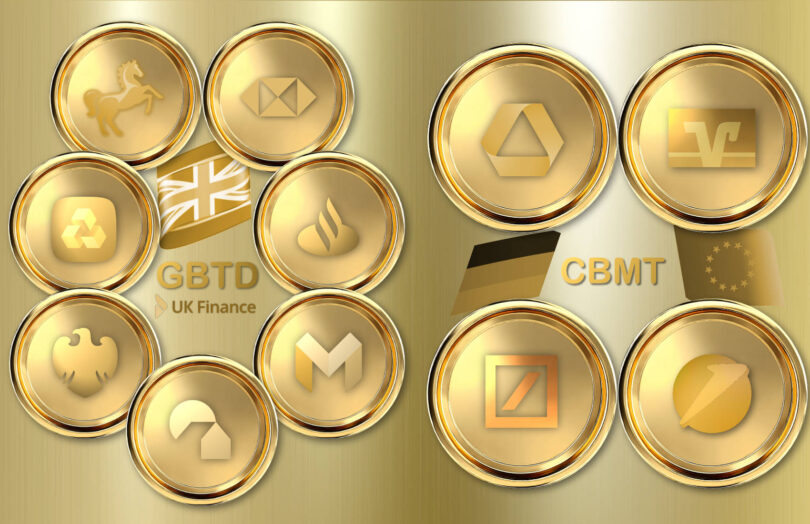
Participant banks: Barclays, HSBC, Lloyds, Monzo, Nationwide, Natwest, Santander
About the CBMT
CBMT traces its roots to the German Banking Industry Committee’s 2021 whitepaper “Europe needs new money”. A 2024 proof of concept with the Federation of German Industries involved five banks (DZ Bank, Deutsche Bank, Commerzbank, UniCredit and Helaba) and five enterprises (Airplus, BASF, Evonik, Mercedes Benz and Siemens), testing use cases from streaming payments for industry 4.0 applications to multi currency transfers across three DLT networks. The concept is for banks to issue deposit tokens onto the third party industry blockchains where corporates run their business processes.
A pre-production sandbox launched in November 2025 on Oracle’s cloud, with G+D, GFT and UDPN as technical service providers and the CBMT Bridge connecting banks’ existing token systems to industry ledgers. BaFin classified CBMT as a deposit in December 2025, and the first live multibank transactions between Siemens and Evonik followed in May. CBMT targets five banks at launch, initially supporting EUR, USD and JPY.
Participant banks: Commerzbank, Deutsche Bank, DZ Bank, Unicredit
The coordination challenge
Both the GBTD and CBMT cited the number one challenge as coordination, which isn’t a revelation with consortia. Rhiannon Butterfield, UK Finance Director of digital money and payments, noted that each firm has a different perspective, “not only in terms of the types of markets that they serve and their own strategies, but because each of those firms is simultaneously developing their expertise in what is still quite a novel area within financial services.” That’s a diplomatic way of saying that banks differ in how quickly they’ve advanced in this space.
Enjoying this article? It’s the kind of coverage we produce regularly for Ledger Insights Pro subscribers. This one is ungated. Subscribe to get more like it.
Likewise, for CBMT, DZ Bank’s Expert Digital Currencies, Liv Tschee-Wegert, highlighted the need to coordinate a shared solution despite “different interests, priorities and legacy systems.” She added, “achieving fungibility across participating banks is one of the core conceptual challenges of the model. Without broad alignment, the network effect of CBMT is difficult to achieve.”
This has already had a design impact. In the early days, GBTD explored a unified ledger where banks natively issue on a single blockchain. Since then, many banks launched their own single bank ledgers, so the projects moved to provide clearing and interoperability mechanisms for existing single ledger systems. CBMT can also help banks that have yet to issue their own tokenized deposits to get started, and GBTD envisages something similar.
The GBTD and CBMT expect a far wider range of banks to join over time, with openness a key message of both projects.
Regulatory and legal clarity
Regarding impediments, both projects mentioned regulatory clarity next, but with a different emphasis. UK Finance described the Bank of England, FCA and HM Treasury as being proactive and supportive and giving comfort to firms that they should engage in this area. Plus, the legal equivalence to deposits is a benefit compared to other forms of digital money. That said, Butterfield did mention a few areas that might need more attention such as payment services regulation in the light of agentic payments, programmability and the use of smart contracts. Yesterday, HM Treasury launched a consultation on revising payment services regulation.
She also highlighted discussions with regulators about applying compliance requirements more progressively while a platform is new and scaling, to avoid institutions needing to spend millions on compliance before a single transaction is executed. “That’s clearly a roadblock to effective innovation,” she said. New solutions can be delivered in a safe and controlled manner, but with some allowance for agility.
For CBMT, the recognition of a tokenized deposit as a deposit is the stage it’s at, and is much more complex because of the number of countries involved. In December 2025, the German regulator BaFin provided confirmation that a tokenized deposit is classified as a deposit and not e-money under MiCA. But that’s not the case in other EU jurisdictions, and banks are often reluctant to discuss getting involved without that clarity. Some countries are becoming more supportive, but that’s sometimes because of the perceived threat of stablecoins. “A harmonised legal classification as a deposit is still missing in Europe, and this remains urgently needed,” said Tschee-Wegert.
The European Central Bank has now taken up the baton, with Executive Board member Piero Cipollone recently raising the topic before the EU Parliament’s ECON Committee. “What is a tokenized deposit in Europe? We don’t know. Are we going to treat them along national lines and therefore fragment the market again, or are we going to provide European regulation?” he asked. Plus, there are rumors that the European Commission may be planning to provide some clarity as part of MiCA v2.
Other challenges
Beyond these consortia and regulatory points the two initiatives diverged a little in terms of other factors that are slowing down progress. GBTD ranked the third challenge as experimentation fatigue. UK Finance’s Butterfield pointed to resource pressures with multiple initiatives moving towards pilot phases. She notes the interest is there but believes the challenge is perhaps more about the scarcity of internal resources with appropriate skills in this area, alongside budgetary pressures.
Arguably the strain should be worse for European banks, even though DZ Bank didn’t raise it. For UK banks the biggest draws on digital money resources are GBTD and the Digital Securities Sandbox, although some are also involved in other initiatives such as Fnality and Finteum FX swaps. Eurozone banks face Wero, the digital euro and Pontes on top.
CBMT talked about market perception in the early days. Banks didn’t fully grasp how CBMT was not simply commercial bank money on blockchain but an upgrade enabling programmability, richer data and transparency. Tschee-Wegert described it as being “less visible and less exciting than stablecoins issued by new market players.” The upside is stablecoins have now created awareness around digital money and the need for a European solution.
Over the years Ledger Insights has seen numerous DLT projects announcing they are in production, while just needing banks to integrate. In some cases, delays in integrating with bank systems has been the death of the project. So the following comment from DZ Bank is not surprising. “The harder part is integrating tokenised money into existing bank and industry infrastructure and processes, including core banking, treasury, compliance, payment and market infrastructure, and ensuring interoperability with today’s regulated financial ecosystem,” said Tschee-Wegert.
An upgrade takes time
Tschee-Wegert argues that CBMT is more than a payment solution. It is an upgrade of commercial bank money, and in her view its full potential will only materialize in a broader tokenized economy, which is still emerging. Seen that way, the current pace may reflect the scale of the ambition rather than a lack of it.
That broader economy is more likely to arrive if national initiatives connect. Butterfield sees a potential role for Project Agorá in knitting the different projects together, with each acting as a national hub. That could mean CBMT in Germany and Europe, GBTD in the UK and TCH in the United States. Whether that comes to pass remains to be seen. But the answer to de Cos’s question may be that upgrading commercial bank money is less a technology problem than one of coordination, legal classification and unburdening stretched banks so they can be agile. Those challenges tend to take longer to solve, but they are also precisely where regulators can play a critical role.